

C57BL/6JNifdc-Asgr1tm4(ASGR1)Bcgen/Bcgen • 113491
| Product name | B-hASGR1 mice |
|---|---|
| Catalog number | 113491 |
| Strain name | C57BL/6JNifdc-Asgr1tm4(ASGR1)Bcgen/Bcgen |
| Strain background | C57BL/6JNifdc |
| NCBI gene ID | (Human) |
| Aliases | HL-1; ASGPR; ASGPR1; CLEC4H1 |

Background: ASGR1 is a liver receptor that clears desialylated proteins from blood, and its inhibition reduces cardiovascular risk by promoting cholesterol removal and lowering lipid synthesis.
Gene targeting strategy: The exons 1-9 of mouse Asgr1 gene that encode signal peptide, extracellular domain, transmembrane domain, cytoplasmic region and 3’UTR were replaced by human counterparts in B-hASGR1 mice. The promoter and 5’UTR region of the mouse gene were replaced by human counterparts.
Validation:
Application: This product is used for pharmacodynamics and safety evalsuation of cardiovascular diseases.

Gene targeting strategy for B-hASGR1 mice. The exons 1-9 of mouse Asgr1 gene that encode signal peptide, extracellular domain, transmembrane domain, cytoplasmic region and 3’UTR were replaced by human counterparts in B-hASGR1 mice. The promoter and 5’UTR region of the mouse gene were replaced by human counterparts. The human ASGR1 expression is driven by the endogenous human ASGR1 promoter, while mouse Asgr1 gene transcription and translation will be disrupted.

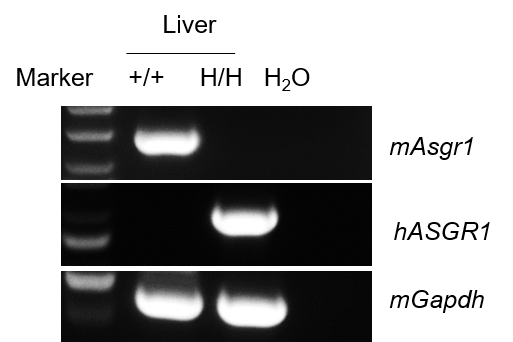
Species-specific analysis of ASGR1 gene expression in wild-type C57BL/6JNifdc mice and homozygous humanized B-hASGR1 mice by RT-PCR. Liver was collected from wild-type C57BL/6JNifdc mice (+/+) and homozygous B-hASGR1 mice (H/H). Mouse Asgr1 mRNA was detectable only in wild-type C57BL/6JNifdc mice. Human ASGR1 mRNA was detectable only in homozygous B-hASGR1 mice, but not in wild-type C57BL/6JNifdc mice.
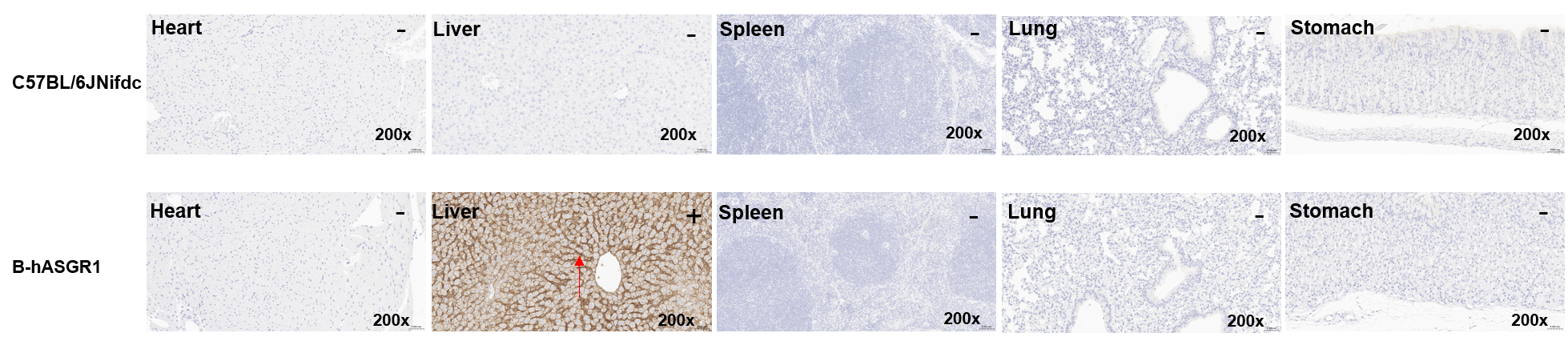
Immunohistochemical (IHC) analysis of ASGR1 protein expression in C57BL/6JNifdc wild-type (WT) mice and B-hASGR1 mice. The heart, liver, spleen, lung, and stomach were collected from C57BL/6JNifdc (+/+) and homozygous B-hASGR1 mice (H/H) (female, 6-week-old), and analyzed by IHC with anti-ASGR1 antibody (ab254261). Human ASGR1 was only detectable in homozygous B-hASGR1 mice. The arrow indicates tissue cells with positive ASGR1 staining (brown). Scale bar = 50 µm.


The inhibitory efficiency of the ASGR1-targeted nucleic acid drugs in homozygous B-hASGR1 mice. B-hASGR1 mice were randomly divided into four groups (6-8 weeks old, female and male). The human ASGR1 targeted nucleic acid drugs (N-ER-FY018074M6L96-analog), and PBS were administered to the mice individually. The mice were sacrificed on day 14, and the liver tissue was collected to detect the expression level of human ASGR1 protein by IHC with anti-ASGR1 antibody (ab254261). (A) The schematic diagram of experimental processing. (B) The expression of human ASGR1 protein in the liver after treatment. The human ASGR1 in the treatment group was reduced compared to the control group, demonstrating that B-hASGR1 mice provide a powerful preclinical model for in vivo evalsuation of human ASGR1-targeted nucleic acid drugs. Values are expressed as mean ± SEM.
