

NA • 322566
| Product name | B-hSEZ6 B16-F10 |
|---|---|
| Catalog number | 322566 |
| Strain name | NA |
| Strain background | C57BL/6J |
| NCBI gene ID | (Human) |
| Chromosome | 11 |
| Aliases | sez-6; BSRP-C; D11Bhm177e |
| Tissue | Skin |
| Disease | Melanoma |


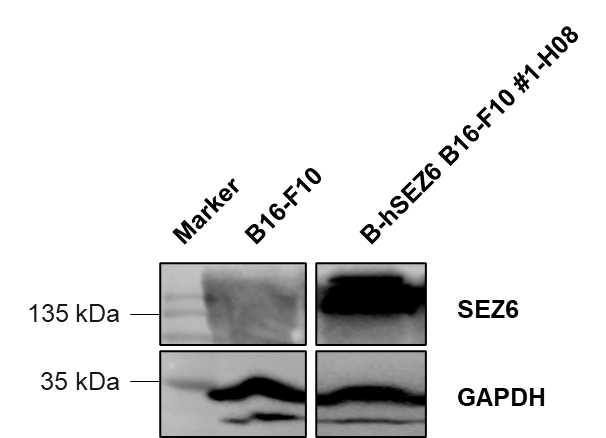
SEZ6 expression analysis in B-hSEZ6 B16-F10 by western blot. Single cell suspensions from wild-type B16-F10 and B-hSEZ6 B16-F10 cultures were stained with anti-hSEZ6 antibody (Invitrogen, PA5-70720). Human SEZ6 was detected in the B-hSEZ6 B16-F10 cells but not wild-type B16-F10 cells. The 1-H08 clone of B-hSEZ6 B16-F10 cells was used for in vivo experiments.

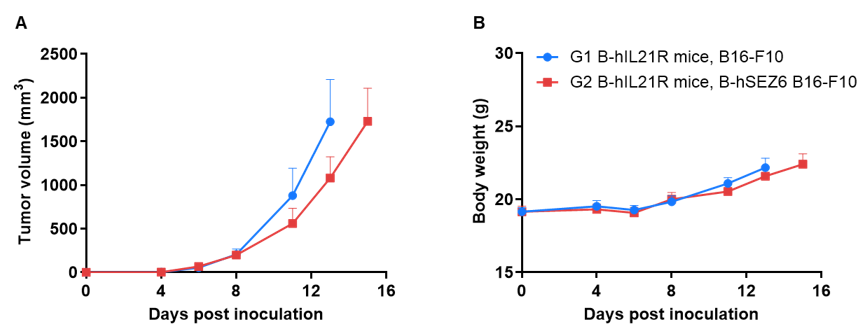
Subcutaneous tumor growth of B-hSEZ6 B16-F10. B-hSEZ6 B16-F10 (2×10⁵) and wild-type B16-F10 cells (2×10⁵) were subcutaneously implanted into B-hIL21R mice (Female, 8-week-old, n=6). Tumor volume and body weight were measured three times a week. (A) Average tumor volume. (B) Body weight. Volume was expressed in mm3 using the formula: V=0.5 × long diameter × short diameter2. Results indicate that B-hSEZ6 B16-F10 cells were able to establish tumors in vivo and can be used for efficacy studies. Values are expressed as mean ± SEM.
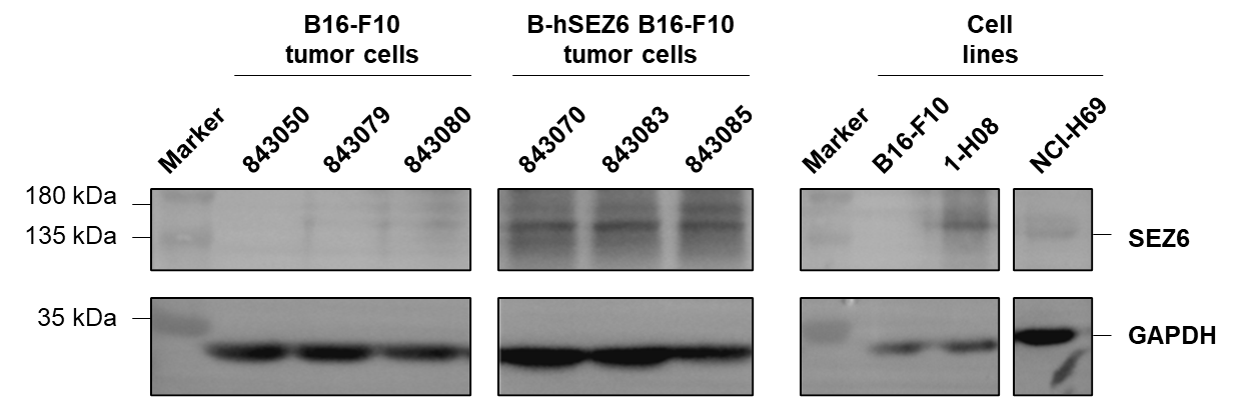
Human SEZ6 expression evalsuated in B-hSEZ6 B16-F10 tumor cells by western blot. B-hSEZ6 B16-F10 cells were subcutaneously transplanted into B-hIL21R mice (Female, 8-week-old, n=6). At the end of the experiment, tumor cells were harvested and assessed with anti-SEZ6 antibody (abcam, ab314233). Human SEZ6 was expressed on the surface of tumor cells. Therefore, B-hSEZ6 B16-F10 cells can be used for in vivo efficacy studies evalsuating anti-SEZ6 antibodies.
